
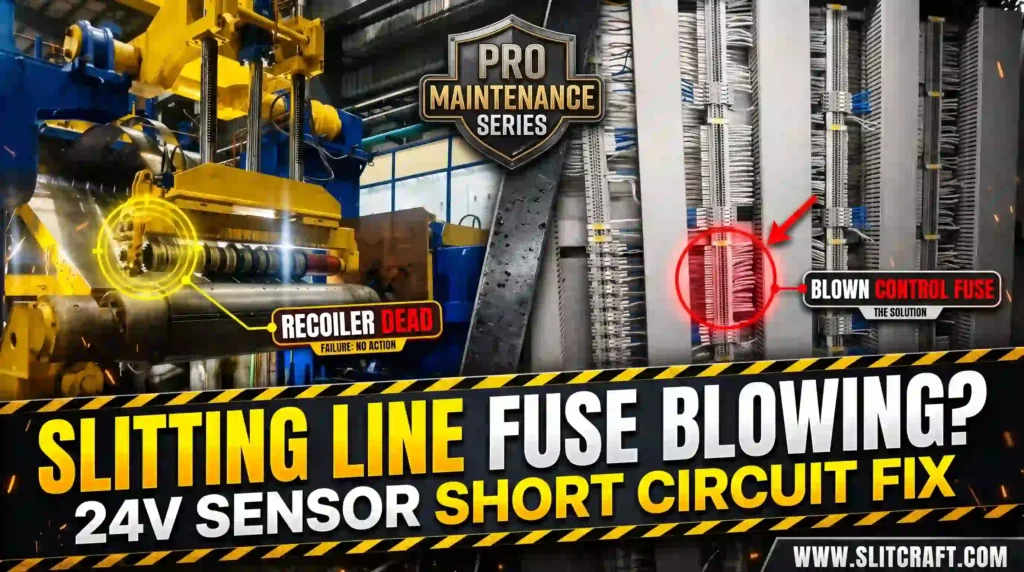
Few shop-floor emergencies create instant panic like a slitting line fuse blowing repeatedly right after a coil changeover—leaving your entire recoiler unit dead while operators wait to run production.
Recently, we had just finished slitting a batch of 3.9 mm heavy-gauge coil on our slitting line. The operators completed the tooling and separator setup for the next run, fed the leading strip into the recoiler drum, and hit the controls. Nothing moved. Every recoiler function was completely unresponsive.
What looked at first like a simple blown control fuse quickly turned into a puzzle when two brand-new replacement fuses blew the instant power was restored. Here is the exact step-by-step diagnostic trail that led us from the control panel room straight to a bare sensor wire shorting against the machine frame.
Why Does a Slitting Line Fuse Blowing Fault Happen Repeatedly?
When you encounter a slitting line fuse blowing immediately upon replacement, you are not dealing with a weak fuse or temporary voltage fluctuation. You have a direct short-to-ground (dead short) somewhere in your 24V DC or 110V AC control circuit.
On a modern coil slitting line, a single control terminal fuse often protects an entire group of field devices:
-
Proximity and limit sensors mounted along the recoiler and push-off assembly
-
Hydraulic solenoid valve coils
-
Operator desk (pulpit) pushbuttons and selector switches
-
PLC input/output interface relays
If any positive (+24V) wire touches the steel machine frame, the current spikes instantaneously—sacrificing the panel fuse to protect your PLC cards and power supply from permanent damage. (For related relay diagnostics, read our guide on Recoiler Drum Not Expanding Troubleshooting.)
4-Step Diagnosis for a Slitting Line Fuse Blowing Breakdown
When our operators could not find any mechanical jam or loose plug at the recoiler station, they called me to inspect the electrical system. Follow this exact sequence whenever you face a similar power loss:
Step 1: Check the Control Panel Terminal Fuse Indicators
Walk directly into the electrical control panel room and inspect the DIN-rail fuse terminal blocks located behind or alongside your relay boards.
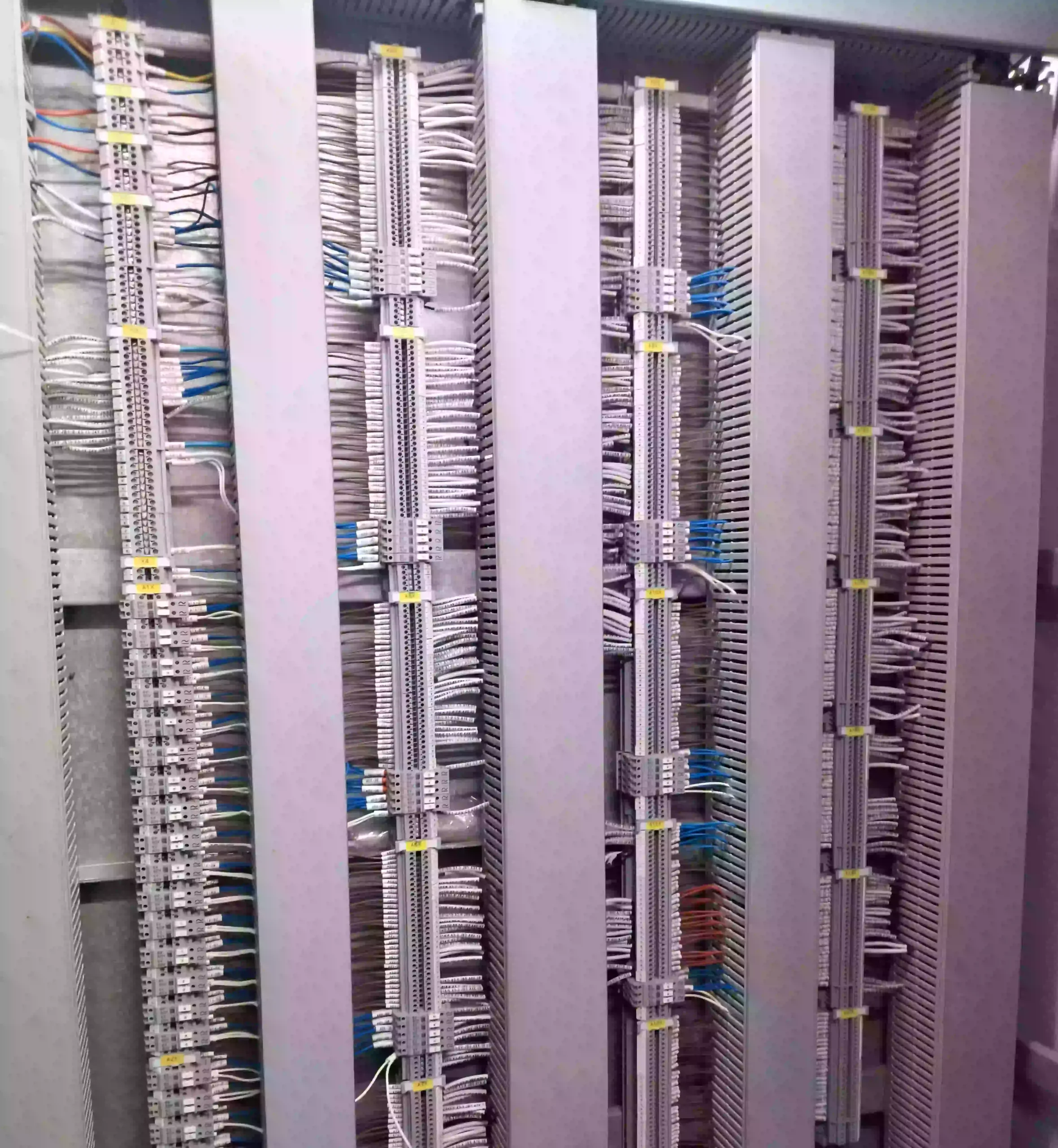
Most industrial fuse holders include a built-in red LED blown-fuse indicator:
-
When the fuse element is healthy, the red LED stays off because current flows through the low-resistance fuse link.
-
When the fuse blows, current bypasses through the internal neon/LED circuit—lighting up the red indicator so you can spot the dead circuit in seconds.
Sure enough, one of the control circuit fuse holders was glowing bright red.
Step 2: Never Keep Feeding New Fuses Into a Dead Short
I pulled out the blown cartridge fuse and installed a fresh replacement of the exact same amperage rating. It blew immediately. Thinking the spare fuse might have been defective, I inserted a second new fuse—and that one blew instantly as well.
Critical Maintenance Rule: If two consecutive fuses of the correct rating blow immediately upon installation, stop replacing fuses. Knowing this was a classic slitting line fuse blowing from a direct short circuit meant we had to isolate the physical field wiring before applying power again.
Step 3: Audit Recent Maintenance Work on the Machine Floor
Instead of disconnecting dozens of wires inside the panel one by one, pause and ask one high-leverage question: “What wiring or sensor was touched most recently on the line?”
That question triggered an immediate memory. Earlier in the shift, a sensor cable on the machine had been damaged, and I had instructed a maintenance technician to rejoin the broken wire.
I walked straight from the panel room to that exact sensor location on the machine floor.
Step 4: Inspect Wire Joints for Bare Copper & Missing Insulation
At the sensor bracket, the mystery solved itself in two seconds:
-
The technician had twisted the broken copper wire ends back together cleanly.
-
However, he had forgotten to wrap PVC electrical insulation tape around the bare copper joint.
-
During the 3.9 mm coil setup, machine vibration shifted the exposed wire until it rested directly against a steel structural rod on the frame.
Every time I inserted a new fuse in the panel room, the 24V DC supply flowed straight through that bare joint into the steel rod—creating an instant short-to-ground. (Learn best practices for industrial electrical wire splicing and insulation to prevent ground faults in harsh steel-plant environments.)
How We Restored the Line in Under 3 Minutes
Once the exposed wire joint was located, the permanent fix took almost no time:
-
Separated the bare joint away from the steel rod and verified no other conductors were nicked.
-
Wrapped the splice tightly with high-grade PVC electrical insulation tape (and secured the cable away from moving parts).
-
Installed one fresh fuse in the glowing red terminal holder inside the control panel room.
-
Tested the recoiler controls—the red LED stayed off, the new fuse held steady, and every recoiler function returned immediately.
Quick Troubleshooting Checklist for Panel Fuse Failures
| Observation in Panel | Probable Root Cause | Recommended Action |
| Red LED glowing on fuse block | Control circuit fuse is open/blown | Inspect circuit before replacing fuse |
| 1st replacement fuse blows instantly | Direct short-to-ground or shorted coil | Do not insert more fuses; check field wiring |
| Fuse blows only when pressing a button | Shorted solenoid coil or pinched actuator cable | Unplug specific solenoid coil and retest |
| Fuse blows immediately on power-up | Constant +24V sensor wire touching machine body | Check recently repaired sensor cables & junction boxes |
Final Thoughts
A rushing repair without proper insulation can shut down an entire shift faster than a major mechanical breakdown. Whenever you finish splicing a sensor cable on a heavy slitting line, double-check that every copper strand is sealed with electrical tape and routed clear of metal rods.
The next time you face a slitting line fuse blowing mid-shift, stop inserting spare fuses and check your field sensor wiring first—have you ever caught a tiny maintenance shortcut causing a massive line stoppage? Drop your story in the comments below!