
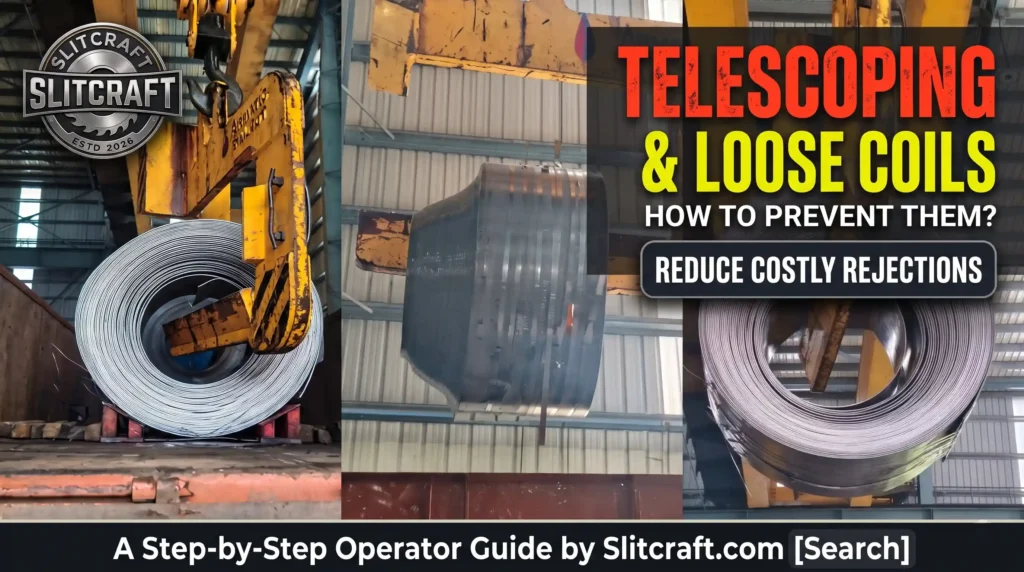
1. Understanding Root Causes: Crown Effect vs. Tension Mismatch
-
The Differential Length Problem: Master hot-rolled (HR) and cold-rolled (CR) coils are naturally thicker at the center than at the edges. When slit into multiple narrow strands, the thicker center strands build diameter on the recoiler faster than the thinner outer edge strands.
-
The Resulting Slack: Because all strands are wound on a single solid recoiler mandrel turning at the exact same rotational speed (RPM), the thinner outer strands quickly become loose and begin to droop into the looping pit.
-
The Recoiler Reaction: If an operator tries to eliminate strand droop by purely ramping up recoiler drive torque, the tight center strands stretch while the edge strands slide laterally across each other, producing immediate telescoping sidewalls.
2. Tension Stand Calibration: The Anti-Telescoping Anchor
-
Drag Pad Tensioners (Felt / Hardwood / Polyurethane):
-
Ensure uniform hydraulic clamping pressure across the entire cross-beam.
-
Inspect drag pads for uneven grooving. A deep groove allows one strand to pass with zero friction while adjacent strands receive heavy drag, causing erratic winding speeds.
-
For dry cold-rolled material, use high-density felt or polyurethane pads. For oily HR coils, use segmented wooden or composite blocks to maintain consistent friction coefficients.
-
-
Roll-Type Tensioners (Roll-Tension Units):
-
Use independent pneumatic or hydraulic cylinder control on both operator side and drive side.
-
Maintain linear back-tension calibrated at 5% to 8% of the material’s yield strength. Insufficient back-tension directly causes inner core collapse when the coil is removed from the drum.
-
3. Overarm Separator Disc Setup and Alignment
-
Axial Play in Separator Arbors: Separator discs must maintain zero axial float. If spacer locking nuts are loose, separator discs oscillate back and forth at line speeds above 80 m/min (260 FPM), pushing strip edges sideways.
-
Disc Lead-In Angle: The overarm separator must sit parallel to the recoiler mandrel centerline within 0.10 mm (0.004″). If the separator shaft is cocked, it introduces continuous lateral camber force directly into the winding bite point.
-
Proper Disc Diameter Progression: Separator discs must clear the growing coil outer diameter (OD) without jamming. Ensure discs penetrate deep enough between strands to prevent strand overlap during initial threading, but retract smoothly as the coil diameter builds.
4. Recoiler Mandrel Gripping & Initial Wrap Anchoring
-
Gripper Jaw Clamping Force: The hydraulic gripper bar inside the mandrel slot must firmly bite the lead strip ends across the entire line width. If the gripper slips on oily strip ends, the core never tightens, producing internal sagging when hoisted by a C-hook.
-
Mandrel Segment Expansion Pressure: Check hydraulic expansion pressure on the 4-segment recoiler drum. Worn wedge segments or weak hydraulic cylinders will slightly collapse under heavy coil weight, instantly loosening inner wraps.
-
The Paper / Fiber Wrap Rule: When starting light gauge or surface-sensitive coils, insert high-friction chipboard or starter paper into the bite point during the initial 2 revolutions to mechanically lock the wraps to the drum face.
5. Shop-Floor Troubleshooting Matrix for Recoiler Defects
| Defect Observed on Floor | Primary Root Cause | Corrective Shop-Floor Action |
| Stepped Sidewall (Telescoping) | Loose separator discs or unequal drag pad pressure | Tighten separator arbor locking nut; verify uniform pad clamp pressure left-to-right. |
| Inner Core Sagging (C-Hook Lift) | Gripper jaw slippage during start; low expansion pressure | Inspect mandrel hydraulic expansion pressure; clean oil residue from gripper teeth. |
| Outer Strand Flutter & Looseness | Master coil thickness crown variation | Verify looping pit depth; increase tension stand drag on outer loose strands. |
| Wavy Edges on Slit Mults | Excessive tension stand clamping pressure | Reduce back-tension cylinder pressure to prevent strip edge stretching. |
| Clock-Springing (Wrap Expansion) | Insufficient circumferential banding tension | Apply high-tension steel strapping immediately before collapsing mandrel segments. |
Shop-Floor Practical Note: Tension Pad Selection and Slack Recovery
Managing surface quality and coil density across varying steel grades requires dedicated friction materials and immediate mechanical correction on the plant floor.
Surface-Critical CR Coil Processing: When processing Cold-Rolled (CR) coils where scratching and surface marring cause immediate customer rejections, rigid drag pads cannot be used. We use specialized ultra-soft pads made of Carper Altima grade carpet and felt. This soft contact material provides steady back-tension without leaving friction burn marks, scratches, or imprints on sensitive sheet surfaces.
Raw Material Core Looseness Fix: If an incoming master coil already has loose inner wraps before slitting, operators insert wooden wedges directly into the coil eye. This locks the loose inner wraps firmly in place and stops the coil from uncoiling or sagging during handling.
In-Process Uncoiler Slack Recovery: When coil wraps become loose on the uncoiler mandrel while the slitting line is running, the operator immediately increases the uncoiler back-tension cylinder pressure. This added reverse pull tightens the loose wraps back against the drum segments before the strip feeds into the looping pit.
Summary & Best-Practice Shop-Floor Workflow
-
Never wind directly from slitter knives to recoiler; rely entirely on the looping pit and tension stand for winding density.
-
Maintain zero axial runout on overarm separator discs and align them exactly with strip cuts.
-
Lock the inner wraps firmly with full hydraulic gripper bite before accelerating the line.
-
Securely apply radial and eye bands while the coil is still supported by the expanded recoiler drum.