Imagine loading an 8.0 mm thick, 1254 mm wide heavy-gauge HR coil. You complete the slitter arbor tooling setup, check the knife clearances, clamp the strip, and initiate Group Jog to thread the line.
Then comes the operator’s worst nightmare: The Uncoiler rotates. The Recoiler pulls. But the slitter cutter arbors remain completely motionless.
For three agonizing hours on our Esmech SMS Group slitting line, our operational shift hit a brick wall. The crew double-checked the hydraulic arbor locking system, verified the motor drive interlocks, checked safety trip signals, and inspected mechanical drive couplings. Every electrical permit appeared normal, yet the cutter arbors refused to draw driving torque.
When production deadlines are ticking and crane hooks are waiting, downtime costs money and creates immense shift tension. Here is the exact diagnostic trail that unraveled the puzzle.
When a heavy-duty rotary slitter fails to turn in sync with the coil handling units, maintenance teams almost instinctively suspect mechanical jamming, gear reducer seizing, or safety gate limit-switch faults.
However, modern PLC-controlled slitting lines (such as systems engineered by Esmech SMS Group / VOS automation) rely on strict operational logic matrices.
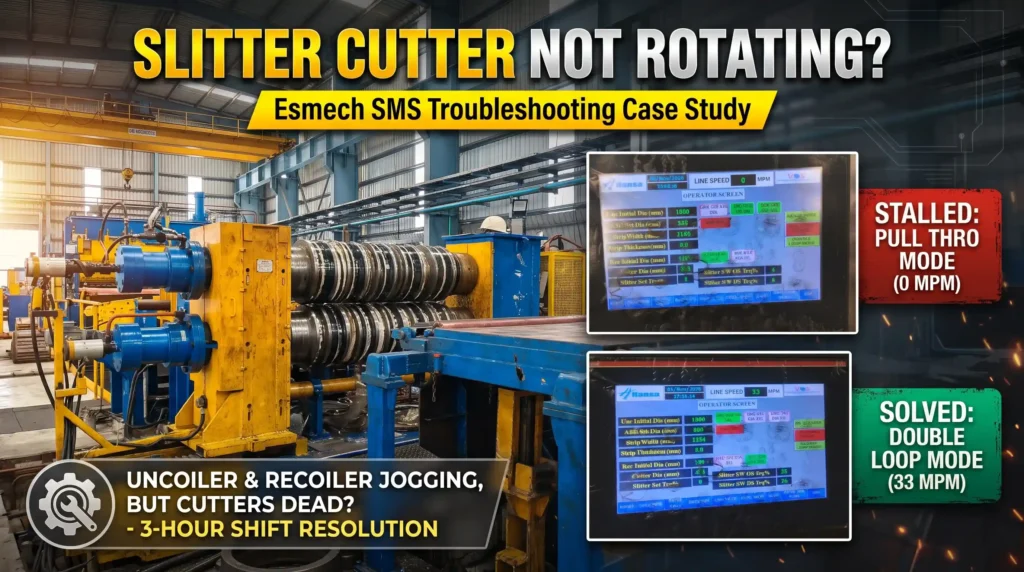
Take a close look at our initial HMI diagnostics:
Shop Floor Diagnostic Log (15:48:02):
The slitter drive motors were drawing barely 4% to 5% base excitation torque. The arbors weren’t jammed—the drive controller was deliberately commanding the slitter arbors to idle freely as passive idlers because it was locked in Pull-Through slitting logic.

Modern coil processing lines feature three primary operational modes on the operator touchscreen desk:
| Operational Mode | Slitter Motor Drive Action | Tension Mechanism | Best Suited Coil Gauge / Process |
| Assist Mode | Motors provide light motorized assistance to overcome arbor inertia. | Recoiler pulls strip; slitter delivers auxiliary torque. | Intermediate gauges, sensitive surfaces, thin strip threading. |
| Pull Thro Mode (Pull-Through) | Slitter motors are completely disengaged or run in pure tension-free freewheel. | Recoiler pulls the strip entirely through passive knives. | Thinner gauges, straight cutting without loop pits. |
| Double Loop Mode | Slitter arbors are independently speed & torque driven by dedicated AC drives. | Deep free loops before & after the slitter isolate line tension. | Heavy gauge HR/CR coils (e.g., 8.0 mm), multi-strand high-precision slitting. |
Why did Pull Thro Mode cause a total stall on this coil run?
-
Heavy Gauge Load Incompatibility: We were processing 8.0 mm heavy-duty hot-rolled strip. Pulling an 8.0 mm plate through passive rotary cutters requires colossal tensile pulling force from the recoiler drum alone.
-
Drive Group Jog Interlock: Under the Esmech SMS PLC safety sequence, when the HMI is toggled into Pull Thro Mode, the slitter inverter drive receives a zero-speed reference during threading jog. It expects the Recoiler to pull the material through the knives mechanically.
-
Torque Suppression: Because the line was halted and the recoiler had not established strip tension grip, the slitter arbors simply rested in freewheel mode, registering a nominal idle torque of 4% to 5%.
To the operating crew standing on the shop floor, it appeared as if the slitter motor had completely tripped or mechanical drive shafts had failed.
The moment we navigated to the main Operator Screen on the HMI desk and analyzed the mode panel, the root cause became obvious.
[ HMI Recovery Action Taken ]
1. Halted Group Jog command.
2. Verified line tension parameters.
3. Deselected "PULL THRO MODE".
4. Toggled and latched "DOUBLE LOOP MODE" on the Touchscreen.
The Result:
Instantly upon switching to Double Loop Mode, the PLC updated drive synchronization:
-
Slitter SW OS Torque jumped from 4% to 25%.
-
Slitter SW DS Torque balanced out at 26%.
-
Drive Jog Permission engaged immediately.
-
Line speed smoothly accelerated to 33 MPM in full synchronized cutting operation!

The arbors rotated effortlessly, shear penetration was clean, and edge camber was completely eliminated without recoiler overload.
To ensure your plant floor never loses 3 valuable production hours to an automation mode mismatch, enforce this pre-start checklist on every coil changeover:
-
[ ] Verify Coil Thickness vs. Drive Mode: Never run coils above 3.0 mm in Pull Thro Mode. Heavy gauges require motorized cutting torque (Double Loop Mode).
-
[ ] Inspect HMI Mode Latch Before Jogging: Verify that the mode indicator reflects a solid green latch before commanding group jog.
-
[ ] Monitor Drive Torque Percentage: If the uncoiler/recoiler are pulling but cutters idle, check the
Slitter SW OS/DS Trq%display. If torque is under 10%, the drive is in passive bypass. -
[ ] Confirm Pit Loop Depths: Ensure photoelectric sensors in the looping pit are clean and active to prevent automatic mode trips back to safety idle.
Shop Floor Golden Rule: In heavy steel coil slitting, a mechanical symptom is often an automation permission waiting to be understood. Master your HMI operational screens before reaching for a wrench.
Psychological Trigger & Final CTA:
Have you ever experienced a baffling slitting line shutdown that turned out to be a simple single-screen HMI configuration? Share your experience in the comments below, or explore our complete guide on Rotary Slitter Knife Grinding & Clearance SOPs to keep your strip edges razor-sharp.