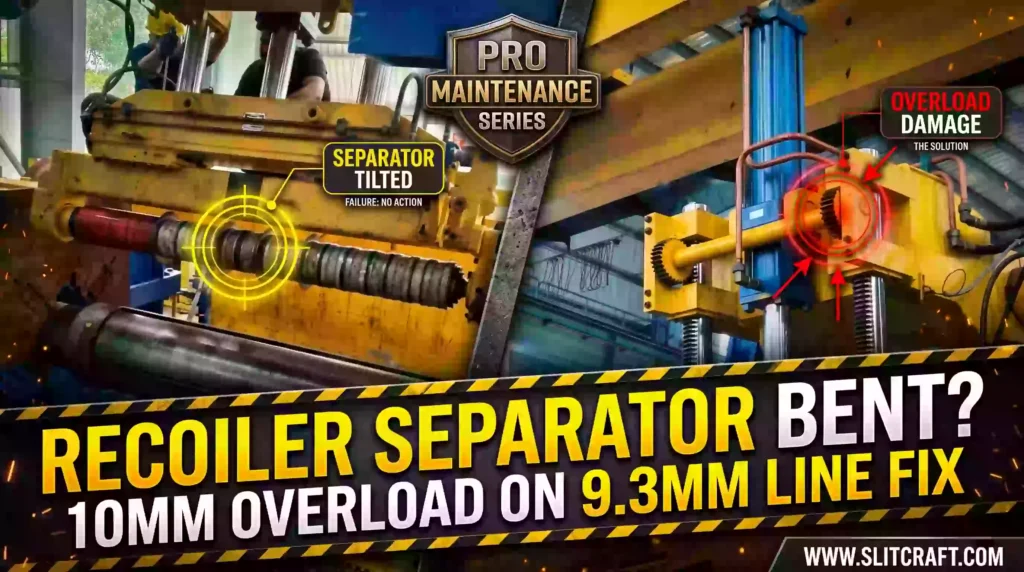
Pushing your slitting line capacity past its rated limit can look tempting during tight coil schedules, especially when a heavy strip cuts through on the first pass. Recently on our shop floor, our slitting line—rated for a maximum thickness of 9.3 mm—was tested with 10 mm coils to see if we could move closer to 12 mm. Two coils were slit under the same setup without immediate trouble, yet lowering and raising the recoiler separator arm for the next coil revealed a bent side guide rod that triggered a 12-to-18-hour breakdown.
In industrial coil slitting, short-term output gains mean very little if an overloaded guide or lifting assembly locks up during changeover. Below is the exact shop-floor breakdown of what happened, why the rod bent, and how plant teams can protect uptime.
How Testing Above Slitting Line Capacity Started
Our machine is rated to process coils up to 9.3 mm in thickness. To check whether 12 mm material was realistic on this line, we loaded 10 mm coils and ran two coils with the same setup.
During the cut, both 10 mm coils passed through the slitting section and wound up. Because the line did not stall mid-cut, it was easy to assume the mechanical components were handling the extra thickness without strain.
What Happened When Lowering and Raising the Separator Arm
The problem appeared right after finishing the 10 mm coil run. We lowered the recoiler separator arm—which keeps slit strips separated during changeover—to set up the tooling and spacing for the next coil.
Once the separator setup adjustments were complete, we tried to raise the arm back up. Instead of lifting cleanly, the assembly stayed stuck and would not travel upward as expected.
Root Cause: Slight Bend in the Side Guide and Lifting Assembly
Close inspection showed a slight bend in the side guide rod connected with the guide roller and lifting cylinder. Even a minor deflection in a guide rod or alignment shaft creates binding when lifting a heavy separator beam under load.
Key mechanical effects included:
-
Extra friction and side thrust along the guide path during vertical travel.
-
Reduced smooth movement of the side guide and roller assembly connected to the cylinder.
-
Sticking during upward repositioning after the separator was lowered for coil changeover.
For related shop-floor troubleshooting guides, check your existing recoiler or hydraulic troubleshooting post on Slitcraft.com.
Why 12 to 18 Hours of Downtime Hurt More Than One Coil
Rectifying the bent side guide rod and realigning the separator assembly took roughly 12 to 18 hours of plant downtime. That single outage cost far more in lost production time, maintenance hours, and delayed dispatch than the margin earned from running a 10 mm coil.
A 12-to-18-hour stop on a coil slitting line affects downstream schedules, operator shifts, and customer commitments. Testing 12 mm territory on a 9.3 mm rated machine turned a trial run into a costly lesson in mechanical limits.
Checklist Before Operating Near Rated Capacity
Never treat a single successful pass as proof that a machine can safely run above its rated thickness. Before any heavy-gauge run or engineering trial, review these practical checks:
-
Respect Rated Limits: Do not exceed rated coil thickness without formal OEM and engineering review—even if 10 mm cuts initially or you want to test up to 12 mm.
-
Inspect Guide Rods and Rollers: Check side guide rods, rollers, and alignment shafts for straightness, play, or binding before lowering and raising separator arms.
-
Verify Hydraulic Gauges and Valves: Check system pressure gauges, directional control valves, and hydraulic fittings so pressure or cylinder resistance is spotted early.
-
Log Changeover Resistance: If a separator arm or guide feels stiff or off-line after lowering, stop and inspect immediately rather than forcing repeated cycles.
Final Takeaway for Plant and Maintenance Teams
Staying within rated slitting line capacity protects your equipment, operators, and daily schedule. A 9.3 mm line pushed toward 12 mm with a 10 mm coil can suffer subtle guide-rod bending that only shows up when you lower and try to lift the separator arm—costing 12 to 18 hours of valuable production time.